Conditional vs Unconditional Lien Waivers: The 2026 Lender's Guide
The four lien waiver types explained, when to collect each one during the construction draw process, state-specific rules, and how lenders pair waivers with satellite progress verification to cut risk.
A lien waiver is a signed document in which a contractor, subcontractor, or supplier gives up the right to file a mechanics lien against a property in exchange for payment. On a construction loan, lien waivers are the legal backbone of the draw process: they are what turns a funded draw into clean title. Get the waiver sequence wrong and a lender can fund a draw in full and still end up behind a $400,000 subcontractor lien on a property it thought was unencumbered.
This guide explains the difference between conditional and unconditional lien waivers, the four standard waiver types, exactly when to collect each one during a draw, the state rules that change the answer, the most common failure modes, and how lenders combine waivers with independent satellite progress verification so the paperwork and the physical reality actually match.
Conditional vs unconditional lien waiver — the core difference
A conditional lien waiver takes effect only if and when payment actually clears. It is a promise: 'once this check clears, I release my lien rights for the work covered.' An unconditional lien waiver takes effect the moment it is signed, whether or not the money ever arrives. It is a receipt: 'I have been paid and my lien rights for this amount are gone.' That single difference — contingent versus immediate — is the whole risk story. Sign an unconditional waiver before the wire lands and the claimant has surrendered its security for money it may never see.
The four standard lien waiver types
(1) Conditional waiver on progress payment — exchanged at the time of a draw request, effective when that draw payment clears, covering work through a stated date. (2) Unconditional waiver on progress payment — issued after the draw payment clears, confirming receipt for that draw period. (3) Conditional waiver on final payment — exchanged when the final payment is requested, effective when it clears, releasing all remaining rights. (4) Unconditional waiver on final payment — issued after final payment clears, extinguishing all lien rights on the project. Every well-run draw process cycles through types 1 and 2 on each draw, then 3 and 4 at closeout.
When to collect each waiver during a construction draw
Best practice for lenders and owners: collect a conditional waiver on progress payment from the GC and every major sub with the draw request package, before funding. After the wire clears, collect the matching unconditional waiver on progress payment for the same period before releasing the next draw. At project close, collect conditional waivers on final payment with the final draw request, then unconditional waivers on final payment before releasing retention. The rule of thumb: conditional going in, unconditional coming out, and never release retention without unconditional finals from everyone with lien rights.
Who should sign
Lien rights extend far past the general contractor. Collect waivers from the GC, every first-tier subcontractor, material suppliers above a dollar threshold (often $5,000–$10,000), equipment lessors where state law grants lien rights, and — on larger jobs — second-tier subs identified through preliminary notices. Reconcile the waiver list against the sworn construction statement and the preliminary notices received; anyone who served a notice but never signed a waiver is an open lien exposure.
State-specific rules that change the answer
Twelve states, including California, Texas, Florida, Georgia, Arizona, Massachusetts, Michigan, Mississippi, Missouri, Nevada, Utah, and Wyoming, prescribe statutory lien waiver forms; a non-conforming waiver can be void. California requires the exact statutory language for each of the four types. Texas requires specific notice and form language and voids advance waivers of lien rights. Other states allow freedom of contract but still bar prospective waivers signed before work begins. Always use the statutory form where one exists, and never accept a blanket 'waiver of all future lien rights' signed at contract execution — in most jurisdictions it is unenforceable and it signals a sloppy process.
The five failure modes lenders see most
(1) Unconditional waivers collected too early — the borrower gets signatures with the draw request instead of after funding, so subs release rights for money still in escrow. (2) Through-date mismatches — the waiver covers work through the 15th while the draw request claims work through the 30th, leaving two weeks of unwaived exposure every cycle. (3) Missing lower-tier claimants — the GC signs, the framing sub doesn't, and the framing sub liens. (4) Amount mismatches — the waiver dollar figure doesn't tie to the pay application line items. (5) Waivers that outrun the work — every signature is in place for a milestone that isn't actually built yet, which is the exact signature of a phantom-progress draw fraud.
Why waivers alone don't prove the work exists
A lien waiver is evidence of payment and released rights. It is not evidence of physical progress. A borrower can assemble a flawless waiver package for a draw covering structural framing on a site where the slab was never poured — every signature genuine, every form statutory, and the underlying claim entirely false. That is why the strongest draw processes pair the legal layer (waivers) with an independent physical layer (verified progress evidence) on every single draw, not just at milestones.
How lenders pair lien waivers with satellite progress verification
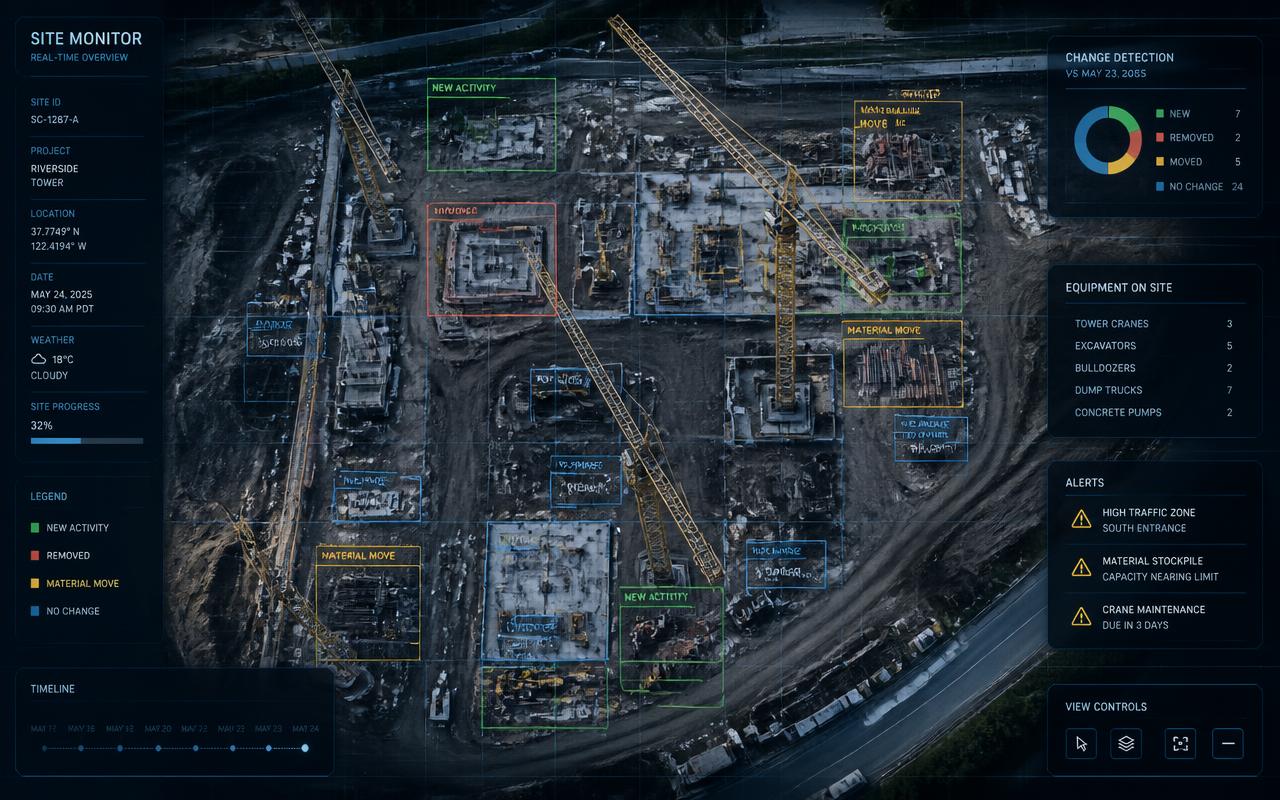
Satellite monitoring captures the site every 3–5 days and quantifies change against the previous baseline, so each draw request can be checked two ways at once. The waiver package answers 'have the claimants been paid and released?' The satellite report answers 'does the work they were paid for physically exist?' Practical workflow: at loan close, enable continuous monitoring so the baseline predates any work. On each draw, match the conditional waivers' through-date to the satellite capture nearest that date, confirm the percent-change supports the claimed milestone, fund, then collect unconditional waivers against the funded amount. Archive the imagery, the change report, and the waiver set together in the loan file. If the loan is ever litigated or sold, that pairing is the cleanest audit trail available.
A lien waiver checklist for every draw
Confirm the correct waiver type for the stage. Confirm statutory form if the project state requires one. Confirm the through-date matches the draw period exactly. Confirm dollar amounts tie to the pay application. Confirm every claimant with a preliminary notice is represented. Confirm unconditional waivers for the prior draw are in hand before funding the next. Confirm independent progress evidence — satellite capture, inspector report, or both — supports the claimed work. Confirm retention is held and released only against unconditional finals.
The bottom line
Conditional waivers protect the claimant; unconditional waivers protect the payer. Sequencing them correctly — conditional with the request, unconditional after the wire — closes the legal gap in a construction draw. Layering objective, independently time-stamped progress data on top closes the physical gap. Lenders who run both layers on every draw stop discovering problems at closeout and start catching them the week they happen.
FAQ
Frequently asked questions
What is the difference between a conditional and unconditional lien waiver?
A conditional lien waiver only becomes effective once payment actually clears, while an unconditional lien waiver is effective the moment it is signed, regardless of whether payment is ever received. Conditional waivers are exchanged with a draw request; unconditional waivers are collected after the funds clear.
When should a lender collect each type of lien waiver?
Collect conditional waivers on progress payment with each draw request before funding, then matching unconditional waivers on progress payment after the wire clears. At closeout, collect conditional waivers on final payment with the final request and unconditional finals before releasing retention.
Are lien waiver forms the same in every state?
No. About a dozen states — including California, Texas, Florida, Georgia, Arizona, and Nevada — prescribe statutory lien waiver forms, and a non-conforming waiver can be unenforceable. Many states also void waivers of lien rights signed before work begins.
Do lien waivers prove construction progress?
No. A lien waiver only evidences payment and released lien rights, not that the work physically exists. Lenders pair waivers with independent verification — such as satellite progress reports or an inspector's report — to confirm the claimed milestone is actually built.
Who needs to sign lien waivers on a construction draw?
The general contractor plus every party with lien rights: first-tier subcontractors, material suppliers above the lender's threshold, equipment lessors where state law grants rights, and any lower-tier party that served a preliminary notice.
Pricing
Start monitoring your sites this week
Month-to-month plans, cancel anytime. Every plan includes weekly satellite captures, AI change detection, and automated PDF reports.
Starter
For lenders and developers monitoring a single active project.
- 1 active site
- Weekly satellite captures
- Automated PDF reports
- Email support
Growth
For portfolios of 2–25 active loans or projects.
- Up to 25 sites
- Daily captures + alerts
- Branded reports + API
- Portfolio dashboard
Enterprise
For institutional lenders, funds, and insurers at scale.
- Unlimited sites
- SSO / SAML
- Dedicated CSM
- Custom SLAs
A traditional in-person draw inspection costs $1,200–$3,500. Satellite monitoring delivers weekly verification for a fraction of that — see the full pricing page for volume discounts.