How to Monitor Construction Site Progress: A Step-by-Step System for 2026
A practical, step-by-step system for monitoring construction site progress — what to measure, how often, which tools to use at each phase, how satellite imagery gives you a weekly independent record, and the exact escalation rules that turn observation into action.
Monitoring construction site progress means answering one question repeatedly and defensibly: is the physical work on the ground keeping pace with the schedule and the money already spent? Most teams answer it with photographs the contractor took, a percentage the contractor calculated, and a narrative the contractor wrote. That is not monitoring — that is reporting. Real monitoring is a repeatable system with a fixed baseline, a fixed cadence, an independent evidence source, a defined measurement method, and written rules for what happens when the numbers disagree. This guide walks through that system step by step, in the order you should build it.
Step 1 — Set the baseline before any work starts
Every meaningful progress measurement is a comparison, which means the single most valuable observation you will ever take is the one from before the first shovel hits the ground. Capture the site at notice to proceed or loan close: the raw parcel, existing structures, vegetation, access roads, and adjacent conditions. Pair that visual baseline with the schedule of values and the baseline CPM schedule, and record the planned percent-complete curve month by month. Teams that begin monitoring in month five never recover the ability to say what changed, because there is nothing to change from. If you are already mid-project, set the baseline today and accept that the first three captures are calibration rather than evidence.
Step 2 — Decide what 'progress' actually means on this project
Percent complete is not one number; it is at least four, and confusing them is the most common source of draw disputes. Cost-based percent complete is dollars spent over total budget — easy to compute and easy to inflate with stored materials and front-loaded line items. Schedule-based percent complete is activities finished over activities planned, which tracks the critical path but ignores partially done work. Physical percent complete is observed installed quantities over total quantities, which is the only version that reflects reality on the ground. Earned-value percent complete blends cost and schedule into SPI and CPI. Pick physical progress as your source of truth and use the others as cross-checks; when cost progress runs ahead of physical progress by more than a few points, you have found the problem before it becomes a loss.
Step 3 — Choose a cadence, and make it independent of anyone's calendar
Monthly monitoring means a stall can run five weeks before anyone notices, and it means every observation is scheduled — which means the site is prepared for it. Weekly is the practical floor for active vertical construction, and every three to five days is achievable when your evidence source does not require a person to travel. The rule of thumb: your monitoring interval should be shorter than the shortest problem you cannot afford to miss. If a two-week work stoppage would trigger a covenant issue, monthly monitoring is structurally incapable of protecting you. Cadence matters more than resolution — a mediocre observation every week beats a perfect one every quarter.
Step 4 — Match the tool to the phase
Different phases expose different evidence, so the tool that answers the question changes as the building rises. Sitework and earthwork: satellite imagery for extent and sequence, drone flights for cut-and-fill volumetrics and stockpile quantities. Foundations and slabs: satellite imagery confirms the pour footprint and sequence; an inspector confirms rebar, embeds, and specification compliance. Structure and envelope: satellite imagery tracks floor-by-floor rise, roof deck, and crane presence extremely well, because all of it is visible from above. Interior rough-in, MEP, and finishes: nothing overhead can help — this is inspector and jobsite-camera territory, and it is where your inspection budget should be concentrated. Sitework closeout, paving, and landscaping: back to overhead imagery. The mistake is buying one tool and grading it against every phase.
Step 5 — Establish an independent evidence layer
The weakness in most monitoring programs is not frequency; it is provenance. Photos supplied by the party requesting money fail three tests that matter later: independence (produced by someone with a financial interest in the answer), immutability (timestamps and selection can be curated), and continuity (you only see the frames you were given). An independent layer fixes all three at once. Satellite monitoring has become the standard choice for this because the captures are scheduled by the satellite operator, timestamped outside the transaction, geographically consistent, and continuous from the day monitoring begins. At roughly $149–$199 per site per month it is also the only continuous option cheap enough to run on every site in a portfolio rather than just the flagship project.
Step 6 — Quantify change instead of describing it
'Looks like they poured the slab' is an opinion. Change detection converts consecutive observations into numbers: percent of the site footprint that changed since the last capture, the direction of change, the inferred construction phase, and whether the change rate is accelerating or flattening. A good progress record contains a week-by-week change series, not a folder of images. Once you have that series, three derived signals do most of the work: change velocity (are we speeding up or stalling), phase confirmation (does the observed phase match the claimed milestone), and drawdown alignment (is cumulative funded percentage tracking cumulative observed progress). When the third one diverges, everything else is noise by comparison.
Step 7 — Verify draw requests against observation, not paperwork
This is where monitoring pays for itself. Workflow: when a pay application arrives, pull the observation nearest its through-date; confirm the phase visible on the ground supports the milestone claimed on the schedule of values; compare the cumulative funded percentage against the cumulative observed physical progress; check the lien waivers and stored-materials line items against what is actually visible in the laydown yard; fund, then archive the imagery and change report in the loan file alongside the waivers. Send an inspector only when the phase is interior-heavy or when imagery and paperwork disagree. Handled this way, inspections stop being a calendar expense and become an exception cost.
Step 8 — Write the escalation rules down
Monitoring without thresholds is an archive, and archives do not prevent losses. Define the triggers before you need them, in writing, each with a named owner and a deadline. Useful defaults: no detectable change for 14 consecutive days on an active site; heavy equipment or a tower crane disappearing without a scheduled milestone; a claimed milestone not observable in the corresponding capture; funded percentage exceeding observed physical progress by more than 10 points; a phase sequence violation such as framing claimed before a slab appears; and three consecutive weeks of declining change velocity. Route each trigger to a person, not a distribution list, and give it a response window measured in days.
Step 9 — Produce a progress report anyone can act on in two minutes
A useful construction progress report has seven parts: the current capture with the prior capture beside it, the quantified percent change for the period, cumulative physical progress against the planned curve, the observed construction phase, any triggered exceptions, funded-versus-observed alignment, and a one-line recommendation. Everything else is decoration. Distribute it on the same day every week so it becomes a ritual rather than a request, and keep the format identical from week one to closeout so a reader can compare month three to month eleven without re-learning the document.
Step 10 — Close the loop with the field
Remote monitoring is not a replacement for the superintendent; it is a way to make the conversation with the superintendent shorter and more specific. Instead of 'how are we doing?', the weekly call becomes 'change velocity dropped to near zero for two weeks and the crane is gone — what happened, and what is the recovery plan?' The best programs share the same report with the borrower or GC rather than using it as a gotcha, because a contractor who knows their progress is independently observed every week behaves differently at draw time than one who does not. Transparency is a control, not just a record.
What this system catches that periodic reporting misses
Silent stalls, where work stops between scheduled inspections and funded draws continue against a static site. Phantom progress, where a milestone is claimed that a chronological record makes immediately falsifiable. Equipment theater, where machinery appears the week of an inspection and vanishes afterward — visible only when you observe every week, not the scheduled ones. Sequence violations that are physically impossible and obvious in a time series. And slow-motion divergence, where cost progress drifts a few points ahead of physical progress every month until the last draw cannot be justified. Projects under continuous observation are typically flagged weeks earlier than those under monthly inspection cycles.
Common mistakes to avoid
Starting mid-project and losing the baseline. Treating cost percent complete as physical progress. Monitoring only the largest project while portfolio risk hides in the small loans nobody reviews. Buying one-off imagery instead of a monitoring subscription, which costs far more per capture because of minimum-order pricing. Collecting evidence without thresholds. Expecting satellites to see interior work, or expecting cameras to cover a site they were never aimed at. And letting the report format drift, which quietly destroys the comparability that made the record valuable in the first place.
A realistic 30-day rollout
Week one: define your evidence standard, pick the sites, and capture or order the baseline for each. Week two: load the schedule of values and planned progress curve, and set the exception thresholds with named owners. Week three: run the first full weekly cycle end to end, including the report and one deliberate escalation drill. Week four: verify a live draw request against observation, archive the evidence in the loan or project file, and lock the report template. From there the system runs itself, and the only recurring human work is exception review.
The bottom line
Monitoring construction site progress well is less about buying a tool and more about installing a loop: baseline, observe on a fixed cadence with independent evidence, quantify the change, compare it to the money, escalate by rule, and report in a fixed format. Do that and inspections become targeted instead of routine, draw disputes become short, and stalls surface in days rather than months.
How Terra Trace IQ fits
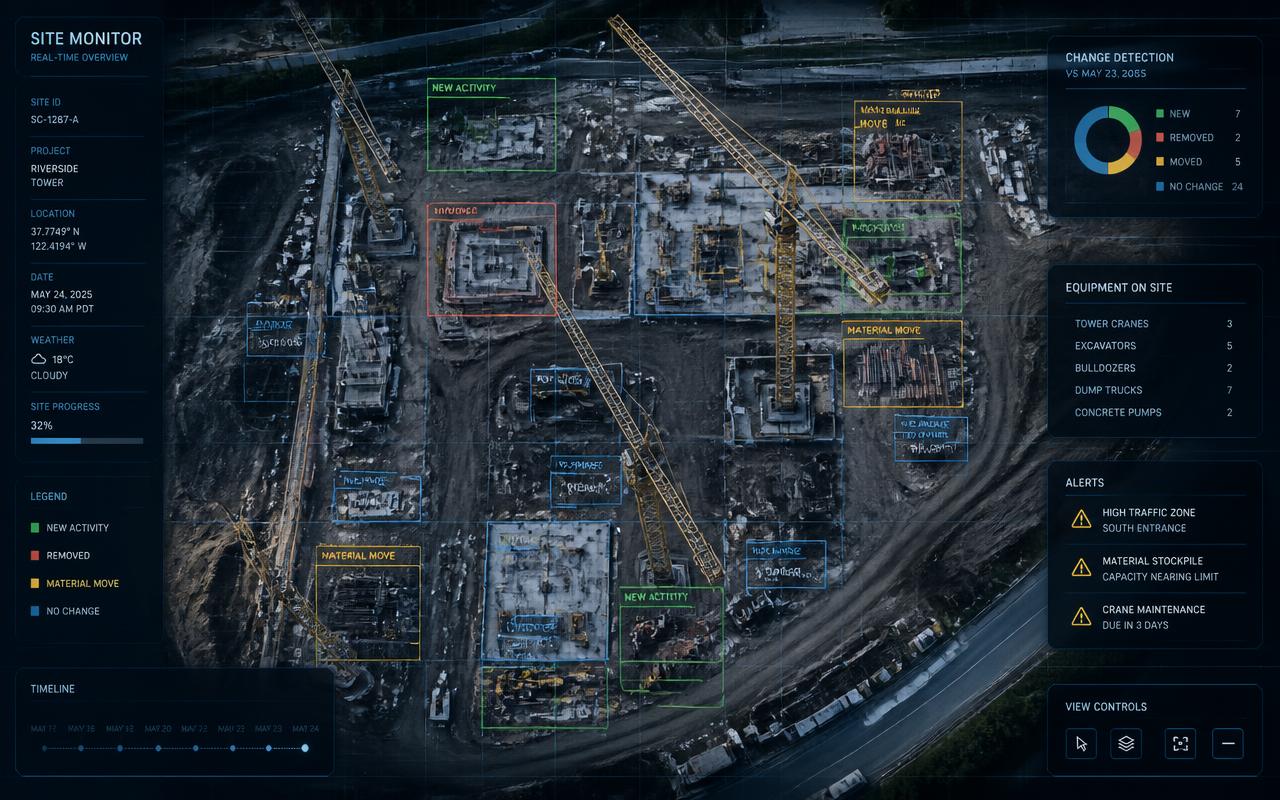
Terra Trace IQ is satellite-powered construction monitoring built for exactly this loop. You drop a pin on a site and we schedule recurring captures — every three to five days on Starter, daily on Growth and Enterprise — fusing free Sentinel-2 and Landsat-9 data with sub-meter commercial imagery when detail is required. AI change detection compares each capture to the prior baseline, quantifies percent change, tags the construction phase, and fires alerts on multi-week stalls, unexpected equipment removal, and progress that lags the draw schedule. You get an automated weekly PDF progress report with annotated before-and-after overlays, and portfolio users get a dashboard color-coded by progress velocity across every active site. Plans start at $199 per site per month, month-to-month, with branded reports, CSV and PDF export, and a REST API for loan-management integrations on Growth and above. Request a demo and we will monitor your own active sites so you can compare our weekly record against what your inspection reports told you.
FAQ
Frequently asked questions
How do you monitor construction site progress?
Set a visual and schedule baseline before work starts, observe the site on a fixed cadence with an independent evidence source, quantify the change between observations rather than describing it, compare cumulative physical progress against cumulative funding, escalate by written rules when they diverge, and issue the same report format every week. The tool changes by phase: overhead imagery for sitework, structure and envelope; in-person inspections for interior rough-in and finishes.
How often should construction progress be monitored?
Weekly is the practical floor for active vertical construction, and every three to five days is achievable with satellite monitoring because no travel is required. Monthly inspection cycles allow a stall to run five weeks before detection. The rule: your monitoring interval must be shorter than the shortest problem you cannot afford to miss.
What is the best way to measure percent complete on a construction site?
Physical percent complete — observed installed quantities over total quantities — is the only measure that reflects what actually exists on the ground. Cost-based percent complete inflates with stored materials and front-loaded line items, and schedule-based percent complete ignores partially finished work. Use physical progress as the source of truth and treat cost and schedule percentages as cross-checks; a gap of more than about ten points between funded and observed progress warrants investigation.
Can you monitor construction progress remotely?
Yes, for everything visible from above: clearing, grading, excavation, foundation slabs, structural steel, floor-by-floor rise, roof deck, paving, laydown yards, stockpiles, cranes, and heavy equipment. Satellite monitoring services deliver recurring captures, automated change detection, and weekly reports for roughly $149–$199 per site per month. Interior work such as MEP rough-in, drywall, and finishes still requires an on-site inspection.
What tools are used to monitor construction site progress?
Four mainstream tools, each answering a different question: third-party in-person inspections (about $1,200–$3,500 per visit) for interior work and specification compliance; fixed jobsite cameras (about $200–$600 per camera per month) for continuous coverage of one field of view and security; drone surveys (about $400–$1,500 per flight) for centimeter-level accuracy and volumetrics; and satellite imagery monitoring (about $149–$199 per site per month) as the continuous, independent, site-wide baseline.
How do lenders verify construction progress before funding a draw?
They match the pay application to an observation taken near its through-date, confirm the construction phase visible on the ground supports the milestone claimed on the schedule of values, compare cumulative funded percentage against cumulative observed physical progress, check stored-materials claims against the visible laydown yard, then fund and archive the imagery and change report in the loan file alongside the lien waivers. Inspections are reserved for interior-heavy phases and for draws where imagery and paperwork disagree.
What should a construction progress report include?
Seven elements: the current capture beside the prior capture, quantified percent change for the period, cumulative physical progress against the planned curve, the observed construction phase, any triggered exceptions, funded-versus-observed alignment, and a one-line recommendation. Keep the format identical from the first week to closeout so any two periods can be compared directly.
What are the warning signs that a construction project is falling behind?
No detectable change for fourteen consecutive days on an active site; a tower crane or heavy equipment disappearing without a scheduled milestone; a claimed milestone that is not observable in the corresponding capture; funded percentage exceeding observed physical progress by more than ten points; phase sequence violations such as framing claimed before a slab appears; and three consecutive weeks of declining change velocity.
Pricing
Start monitoring your sites this week
Month-to-month plans, cancel anytime. Every plan includes weekly satellite captures, AI change detection, and automated PDF reports.
Starter
For lenders and developers monitoring a single active project.
- 1 active site
- Weekly satellite captures
- Automated PDF reports
- Email support
Growth
For portfolios of 2–25 active loans or projects.
- Up to 25 sites
- Daily captures + alerts
- Branded reports + API
- Portfolio dashboard
Enterprise
For institutional lenders, funds, and insurers at scale.
- Unlimited sites
- SSO / SAML
- Dedicated CSM
- Custom SLAs
A traditional in-person draw inspection costs $1,200–$3,500. Satellite monitoring delivers weekly verification for a fraction of that — see the full pricing page for volume discounts.