How to Monitor Construction Site Quality: A Complete 2026 System for Inspections, Evidence & Remote Verification
A complete system for monitoring construction site quality in 2026 — quality plans, inspection and test plans, hold points, defect tracking, the metrics that actually predict rework, and how satellite imagery gives lenders and owners an independent, timestamped record of sequence and workmanship conditions.
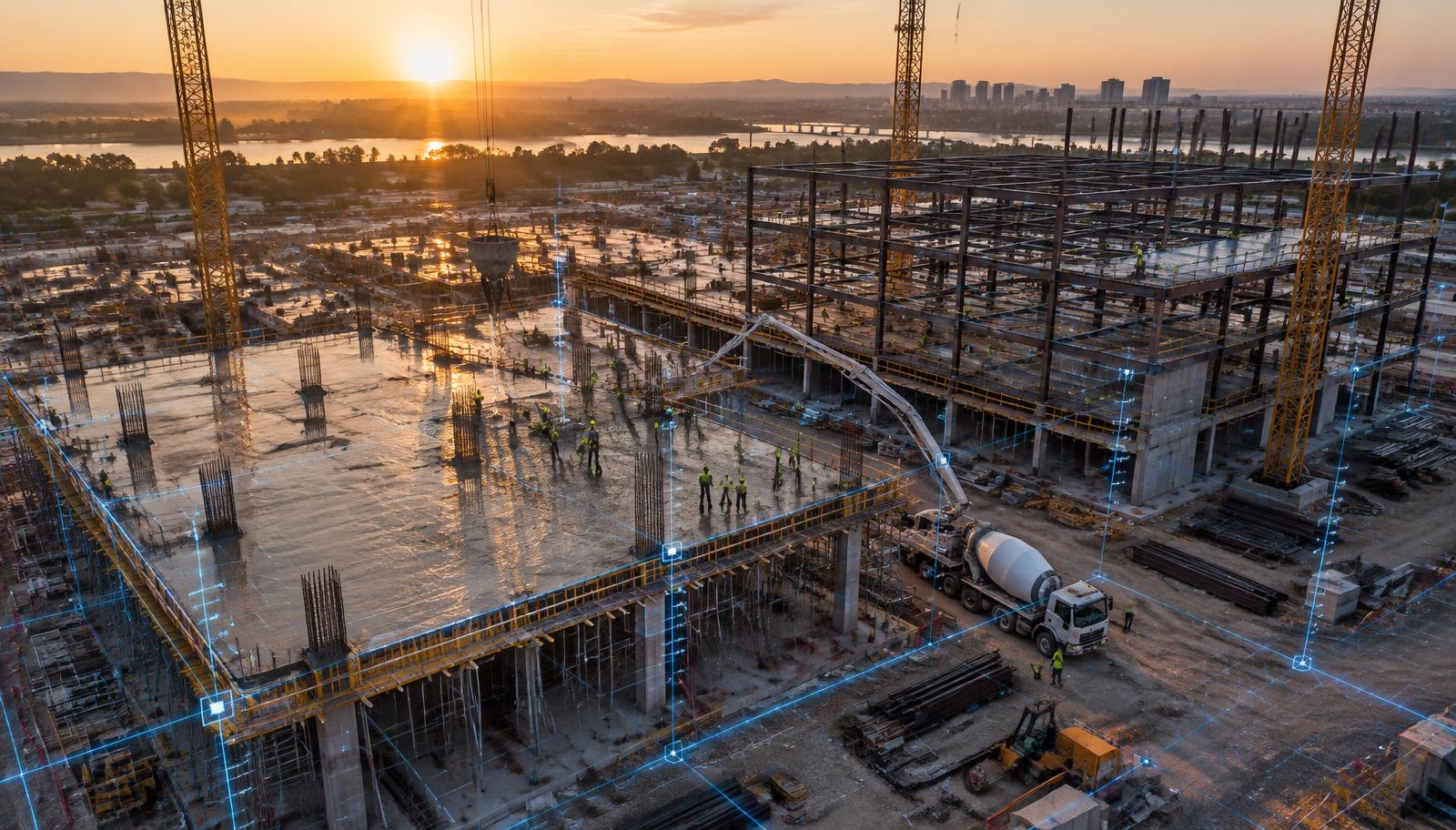
Quality on a construction site is not something you inspect into a building at the end; it is something you monitor into it every week. By the time a punch list is written, the expensive failures — a slab poured over uncompacted subgrade, a wall closed before the rough-in was signed off, an envelope detail installed out of sequence in the rain — are already buried behind finishes. Monitoring construction site quality means running a continuous loop: define the standard, plan the verification, hold the work at defined points, record what was actually observed, quantify the defects, and feed the numbers back into the schedule and the payment process. This guide lays out that loop end to end, including the part most programs skip — an independent, timestamped record of what happened on the ground, which is where remote satellite monitoring now does real work.
Step 1 — Write a quality plan that names standards, not intentions
A quality plan that says 'work shall be performed in a workmanlike manner' is unenforceable. A usable project quality plan names, for every major scope: the governing specification section and code reference, the acceptance criteria with tolerances and units, who verifies it, what evidence is required, and what happens when it fails. Concrete does not 'need to be good'; it needs a documented mix design, slump within a stated range, cylinder breaks at 7 and 28 days against a specified strength, and a written disposition path for low breaks. The plan should be short enough that a superintendent reads it and specific enough that two inspectors reach the same verdict. Attach it to the subcontract, not the project binder — quality requirements that are not contractual are suggestions.
Step 2 — Build an Inspection and Test Plan (ITP) per scope
The ITP is the operational heart of quality monitoring. For each activity it lists the sequence of verification events, the characteristic being checked, the reference standard, the method (visual, measurement, laboratory test, functional test), the frequency or sample size, the record produced, and the responsible party. Typical entries on a vertical project: subgrade proof-roll and compaction testing before the slab; rebar size, spacing, lap length, and cover before any pour; anchor-bolt layout and embed locations before steel arrives; weld inspection and high-strength bolt torque on the frame; air and water testing of the envelope mock-up before production installation; pressure tests on piping and megger tests on feeders before concealment; and commissioning scripts for every mechanical system. Without an ITP, inspection becomes whatever the inspector happened to look at that day.
Step 3 — Use hold points and witness points so verification cannot be skipped
A hold point stops work until an authorized party signs off; a witness point allows work to proceed but requires notification so the party may attend. These are the only mechanisms that reliably prevent the single most expensive category of quality failure — covered work that was never verified. Put hold points where reversal is impossible or ruinous: before concrete placement, before backfill, before insulation and drywall close walls, before waterproofing is covered, before structural connections are fireproofed, and before roofing is covered by ballast or pavers. Each hold point needs a required notice period (24–48 hours is standard), a named releaser, and a written release record. If a hold point is bypassed, treat it as a nonconformance in its own right, independent of whether the underlying work turned out fine.
Step 4 — Inspect on a fixed cadence, and inspect the risk, not the calendar
Quality monitoring has two layers: scheduled verification tied to the ITP, and surveillance walks that sample everything else. Run surveillance at least weekly during active work and daily during high-risk operations such as large pours, structural erection, or envelope installation in adverse weather. Bias attention by consequence: concealment activities, structural connections, waterproofing, fire-rated assemblies, and anything on the critical path. A useful discipline is the first-work inspection — the first installation of each repeating assembly gets a full, documented review with the crew present, establishing the benchmark for the remaining hundreds of repetitions. Correcting a detail on unit one is training; correcting it on unit forty is rework.
Step 5 — Record observations as data, not narrative
Every quality observation should carry a fixed set of fields: date and time, location to the level of grid line or room number, scope and specification reference, observation type (conformance, nonconformance, observation), severity, photographic evidence, responsible subcontractor, required corrective action, due date, and closure verification. Stored this way, the record becomes queryable: which trade generates the most nonconformances, which specification sections fail repeatedly, which floors are trending worse, how long defects take to close. Stored as prose in daily reports, the same information is invisible after week three. Consistency of format is what converts inspection effort into institutional knowledge.
Step 6 — Run a real nonconformance and defect workflow
A defect log with no lifecycle is a wish list. Each nonconformance needs a state machine: raised, assessed for disposition (repair, rework, accept-as-is with engineering concurrence, or reject), assigned, corrected, re-verified, and closed with evidence. Require engineer-of-record concurrence in writing for any accept-as-is disposition, and never allow closure by the party that performed the work. Track aging explicitly — a nonconformance older than 14 days is a schedule problem, and one older than 30 days on a concealment scope is a future claim. The single highest-value metric in this workflow is the percentage of defects closed before the covering activity begins, because everything closed after that point is paid for twice.
Step 7 — Measure quality with a small set of honest metrics
The metrics that predict outcomes are unglamorous: nonconformances per 1,000 labor hours by trade; first-time-right rate on inspected activities; rework cost as a percentage of installed value (the industry benchmark sits in the low single digits and anything above about 5% signals a systemic problem); average days to close a nonconformance; hold-point compliance rate; percentage of ITP records delivered on time; punch-list items per unit at turnover; and warranty claims per unit in the first twelve months. Report them monthly with trend lines, not as a single score. A rising defect count paired with a falling close-out time is a healthy program; a flat defect count with rising aging is a program that has stopped looking.
Step 8 — Verify sequence and conditions independently
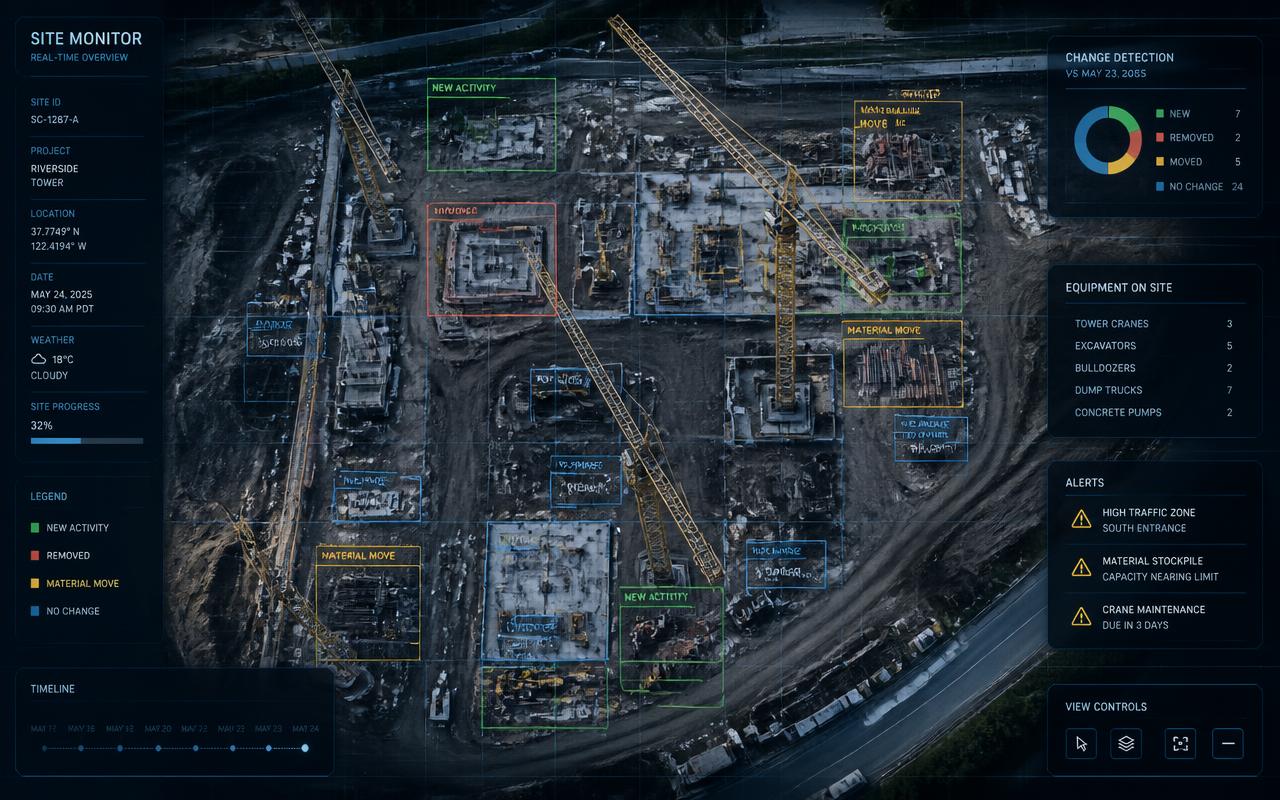
Here is the gap in nearly every quality program: the inspection record is produced, curated, and submitted by the parties with a financial interest in the answer. Photographs can be selected, timestamps can be ambiguous, and the frames you were never sent are the ones that would have mattered. An independent evidence layer fixes provenance without adding site visits. Recurring overhead satellite imagery gives an unbroken, third-party-timestamped chronology of the site: when earthwork actually finished, whether the slab footprint matched the drawings, when structure rose floor by floor, whether roofing went on before or after the framing was closed in, whether stockpiles and laydown material sat exposed for weeks, and whether work proceeded during a weather window that should have stopped it. None of that replaces an inspector's eye on rebar cover — but all of it is checkable against the claimed sequence, and all of it is admissible history rather than someone's recollection.
What overhead monitoring can and cannot verify
Be precise about the boundary, because overselling it destroys trust. Verifiable from above: site preparation and earthwork extent, slab and foundation footprints, structural rise and roof deck completion, envelope closure at a building-scale level, paving and site concrete, exposed material storage and laydown conditions, crane and equipment presence, and the calendar sequence of all of it. Not verifiable from above: rebar placement and cover, concrete consolidation, weld and bolt quality, MEP rough-in, insulation and air-barrier continuity, fire-stopping, and finish workmanship. The correct architecture is a layered one — satellite imagery for continuous, independent sequence and site-condition evidence; in-person and instrumented inspection for everything concealed or tactile. Spend your inspection budget where the imagery cannot see, and stop spending it on trips that confirm a building is still rising.
Step 9 — Tie quality evidence to money
Quality monitoring that is disconnected from payment has no leverage. Make delivery of ITP records a condition precedent for the associated pay application: no compaction reports, no slab payment; no pressure test, no piping payment. Hold retention against open nonconformances on the specific scope rather than against the project globally, so the pressure lands on the responsible trade. For construction lenders, the same principle applies at the loan level — require that each draw package include the quality records for the milestones being funded, and pair them with an independent observation of the site for the draw's through-date. When paperwork claims a milestone the chronological imagery does not support, that is the cheapest moment in the entire project to ask a question.
Step 10 — Close out with a handover package, then watch the warranty period
Turnover quality is its own discipline: complete the punch list by system rather than by room, verify commissioning scripts with functional performance tests, collect as-builts and O&M manuals, confirm training was delivered, and compile the full quality record — ITP sign-offs, test reports, nonconformance closures, hold-point releases, and the chronological site record — into a single handover package. Then keep measuring for twelve months. Warranty claims are the only unbiased audit of your quality program, and they map back to specific trades, specific details, and specific weeks on the schedule. A program that reads its warranty data changes its ITP for the next project; one that does not repeats the same failures with new subcontractors.
Common mistakes that quietly destroy quality programs
Treating safety documentation as quality documentation. Letting the general contractor self-certify concealment work with no independent hold-point release. Inspecting at uniform frequency instead of weighting by consequence. Writing nonconformances without owners or due dates. Allowing accept-as-is dispositions verbally. Photographing everything and analyzing nothing. Starting the record mid-project, so there is no baseline for what the site looked like before the disputed work. And relying entirely on evidence supplied by the party being paid — which is not a quality program at all, but a reporting arrangement.
A 30-day rollout you can actually execute
Week one: write or tighten the project quality plan, name standards and tolerances per scope, and attach it to subcontracts. Week two: build ITPs for the next 90 days of work, set hold and witness points with notice periods and named releasers, and start the baseline site record. Week three: run the first full weekly cycle — scheduled verifications, one surveillance walk, structured observation records, and a first-work inspection on the next repeating assembly. Week four: stand up the nonconformance state machine with aging reports, connect ITP delivery to the pay-application checklist, and verify one draw or pay period against the independent site record. After that, the only recurring work is exception handling and monthly metric review.
The bottom line
Monitoring construction site quality is a loop, not an event: define measurable standards, plan verification per scope, hold the work where reversal is impossible, record observations as structured data, close defects on a clock, measure a handful of honest metrics, keep an independent timestamped record of sequence and conditions, and tie all of it to payment. Do that and quality stops being a subjective argument at turnover and becomes a documented, defensible history that protects the owner, the lender, and the builder who did the work correctly.
How Terra Trace IQ fits
Terra Trace IQ supplies the independent evidence layer this system depends on. You outline a site on the map and we schedule recurring satellite captures — every three to five days on Starter, daily on Growth and Enterprise — fusing free Sentinel-2 and Landsat-9 data with sub-meter commercial imagery when detail is required. AI change detection compares each capture to the last, quantifies percent change, tags the visible construction phase, and alerts you when the observed sequence contradicts the claimed milestone, when a site sits static for weeks, or when funded progress runs ahead of what is physically on the ground. Every capture is third-party timestamped and archived, so your quality and draw files carry a chronology nobody in the transaction produced. Automated weekly PDF reports include annotated before-and-after overlays you can drop straight into a draw package or a dispute file, and Growth and Enterprise add branded reports, CSV and PDF export, and a REST API for loan- and project-management integrations. Plans start at $199 per site per month, month-to-month, cancel anytime. Request a demo and we will monitor your active sites so you can compare our independent weekly record against what your inspection reports told you.
FAQ
Frequently asked questions
How do you monitor construction site quality?
Write a quality plan that names standards and tolerances per scope, build an Inspection and Test Plan for each activity, set hold points before any work that cannot be reversed, run scheduled verifications plus weekly surveillance walks, record every observation as structured data, close nonconformances through a defined workflow with aging limits, measure a small set of metrics such as first-time-right rate and rework cost, and keep an independent timestamped record of site sequence and conditions to verify what the paperwork claims.
What is an Inspection and Test Plan (ITP) in construction?
An ITP is a scope-by-scope table of verification events. For each activity it defines the characteristic being checked, the reference standard and acceptance criteria, the method (visual, measurement, laboratory or functional test), the frequency or sample size, whether it is a hold or witness point, the record produced, and who signs off. It turns 'inspect the work' into a specific, auditable sequence of checks.
What is the difference between a hold point and a witness point?
A hold point stops work until an authorized party inspects and releases it in writing — used before concrete placement, backfill, closing walls, covering waterproofing, and fireproofing structural connections. A witness point only requires notification so the party may attend; work may proceed if they do not. Hold points are the main defense against unverified concealed work.
Who is responsible for quality control on a construction site?
The contractor performing the work owns quality control — building to specification and producing the test and inspection records. The owner, lender, or their representative owns quality assurance — verifying that the contractor's system is working and that the records are real. Keeping the two separate matters: work should never be closed out or released by the same party that performed it.
What quality metrics should construction projects track?
Nonconformances per 1,000 labor hours by trade, first-time-right rate on inspected activities, rework cost as a percentage of installed value (above roughly 5% signals a systemic problem), average days to close a nonconformance, hold-point compliance rate, on-time delivery of ITP records, punch-list items per unit at turnover, and warranty claims in the first twelve months after handover.
Can satellite imagery verify construction quality?
Satellite imagery verifies sequence, extent and site conditions — when earthwork finished, whether the slab footprint matched the drawings, floor-by-floor structural rise, roof deck completion, paving, exposed material storage, equipment presence, and the calendar order of all of it. It cannot verify concealed or tactile work such as rebar cover, weld quality, MEP rough-in or finishes. Used as the independent, timestamped layer beneath in-person inspection, it shows whether claimed milestones actually happened when the paperwork says they did.
How often should quality inspections happen on a construction site?
Scheduled verifications follow the ITP and are fixed to specific activities. Surveillance walks should run at least weekly during active work and daily during high-risk operations such as large pours, steel erection, or envelope installation in adverse weather. Weight frequency by consequence rather than spreading it evenly — concealment activities, structural connections, waterproofing and fire-rated assemblies deserve disproportionate attention.
How do you prevent rework in construction?
Catch defects before the covering activity starts. The practical levers are first-work inspections on every repeating assembly, mandatory hold points before concealment, nonconformance aging limits so defects cannot drift past the point of easy repair, delivery of test records as a condition of payment, and trade-level metrics so recurring failures are traced to a specific subcontractor and detail rather than absorbed into general contingency.
Pricing
Start monitoring your sites this week
Month-to-month plans, cancel anytime. Every plan includes weekly satellite captures, AI change detection, and automated PDF reports.
Starter
For lenders and developers monitoring a single active project.
- 1 active site
- Weekly satellite captures
- Automated PDF reports
- Email support
Growth
For portfolios of 2–25 active loans or projects.
- Up to 25 sites
- Daily captures + alerts
- Branded reports + API
- Portfolio dashboard
Enterprise
For institutional lenders, funds, and insurers at scale.
- Unlimited sites
- SSO / SAML
- Dedicated CSM
- Custom SLAs
A traditional in-person draw inspection costs $1,200–$3,500. Satellite monitoring delivers weekly verification for a fraction of that — see the full pricing page for volume discounts.