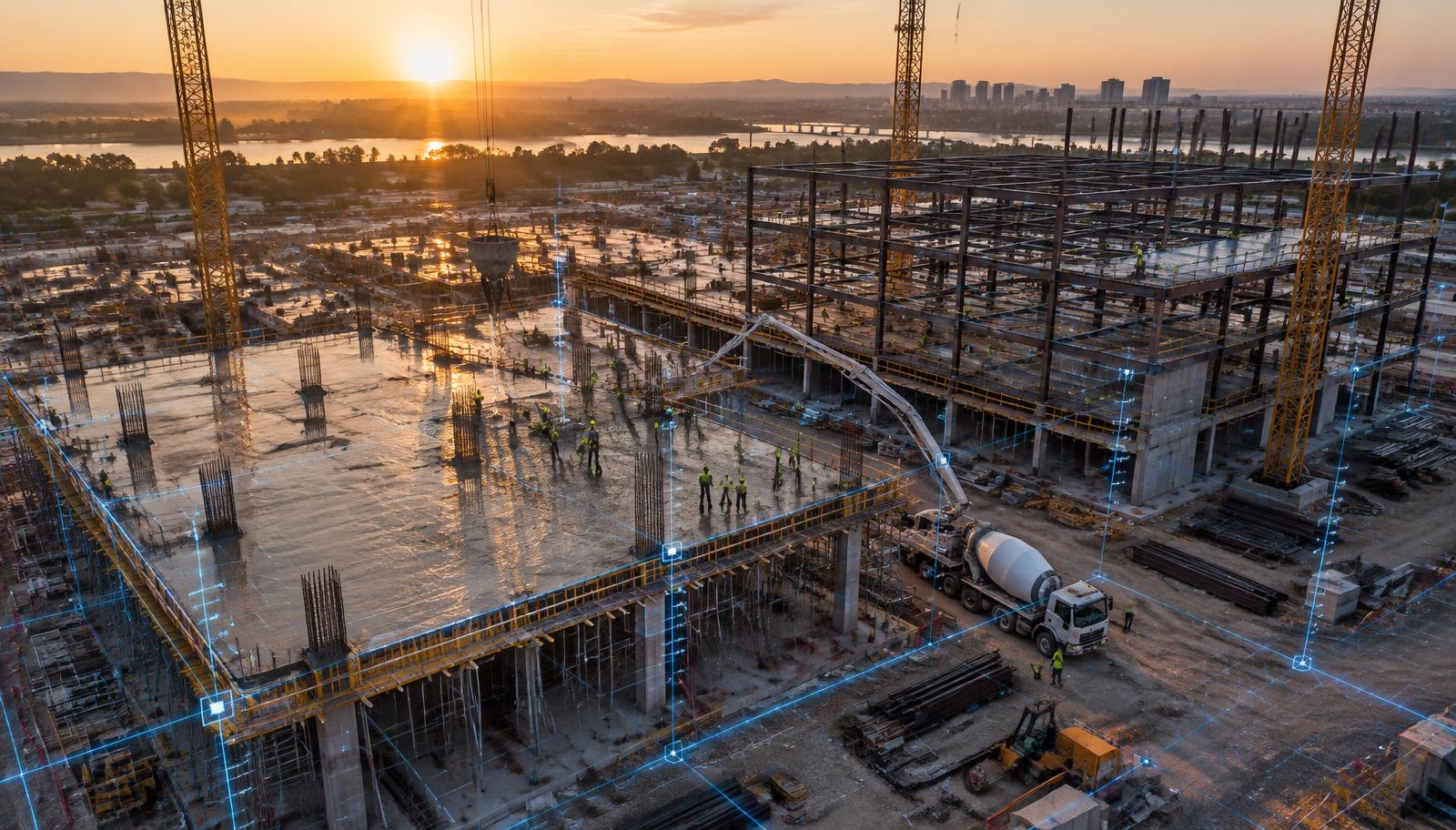
Construction Draw: The Complete Guide to Draws, Schedules & Inspections (2026)
What a construction draw is, how the draw process works, a step-by-step draw schedule template, what a draw inspection covers, and how satellite imagery is replacing the in-person draw inspector.
A construction draw is a scheduled release of loan funds from a lender to a borrower during construction, paid out in installments as physical work is completed rather than as a single lump sum at closing. Draws protect the lender from over-funding a project that could stall, give the borrower predictable cash flow to pay contractors, and create a milestone-by-milestone paper trail of how the loan was actually spent. In 2026, every serious construction loan — vertical or horizontal, residential or commercial — is funded through a draw process, and the mechanics of how that process works are the difference between a smooth build and a lawsuit.
This guide covers what a construction draw is in plain language, the end-to-end construction draw process, a reusable draw schedule template, exactly what a draw inspection covers, what draw inspections cost in 2026, and how satellite-based verification is quietly replacing the drive-by inspector on tens of thousands of active loans.
What is a draw in construction?
A construction draw is a partial disbursement of a construction loan, released only after a defined milestone has been completed and verified. Instead of the lender handing over the full loan amount at closing, the loan sits in escrow and is drawn down in 5–10 increments over the life of the project. Each draw covers the hard costs incurred since the last draw — labor, materials installed, subcontractor progress — plus a proportional share of soft costs like architect fees and permits. The unfunded balance stays in escrow and keeps earning interest until the next draw is approved.
Why lenders use draws instead of lump-sum funding
Three reasons. First, capital preservation — if the borrower defaults at 40% complete, the lender has only funded roughly 40% of the loan, not 100%. Second, milestone control — tying each disbursement to a verified physical state prevents the borrower from spending framing money on finishes. Third, fraud prevention — the draw process forces documented, time-stamped evidence of work-in-place, which is the single strongest defense against phantom-progress schemes.
The construction draw process, step by step
(1) Draw request — the borrower submits a draw package, usually monthly, listing the work completed since the last draw and the dollars requested. (2) Documentation package — signed draw request form (AIA G702/G703 is standard), updated sworn construction statement, lien waivers from the GC and major subs, current permits and inspection sign-offs, dated progress photos, and updated insurance certificates. (3) Draw inspection — a third-party inspector, or increasingly a satellite-verified report, confirms that the work claimed on the draw request physically exists on the site. (4) Lender review — underwriting or the construction loan administrator matches the draw request line-by-line against the sworn statement and the inspector's report, adjusts for any discrepancies, and applies retention (typically 5–10% held back on each draw). (5) Fund release — approved funds are wired from escrow, usually into a title company account, and disbursed to the GC and subs against the specific line items funded. Total elapsed time on a well-run draw: 5–10 business days from request to wire.
A typical construction draw schedule template — adjust percentages to your project
Draw 1 — Site prep, demolition, grading, excavation: 5–10%. Draw 2 — Foundation and underground utilities: 10–15%. Draw 3 — Structural framing and roof deck: 15–20%. Draw 4 — Dry-in — roofing, exterior sheathing, windows, doors: 10–15%. Draw 5 — Rough MEP (mechanical, electrical, plumbing): 10–15%. Draw 6 — Insulation, drywall, interior framing: 5–10%. Draw 7 — Finishes — flooring, paint, cabinetry, fixtures: 10–15%. Draw 8 — Final MEP trim, appliances, punch list: 5–10%. Draw 9 — Certificate of occupancy and retention release: 5–10%. Most lenders hold 5–10% retention on every draw, released only at substantial completion once the punch list is closed and the CofO issued.
What is a draw inspection?
A draw inspection — sometimes called a construction progress inspection or a construction draw inspection — is a third-party site visit that verifies the physical work claimed on a draw request actually exists before the lender releases funds. The inspector walks the site, photographs the observed conditions, compares them to the sworn construction statement and the draw request, and issues a report that lists the percent-complete of each budget line item. The report either confirms the requested draw amount, recommends a reduction, or flags line items where claimed progress isn't visible on the ground.
What a draw inspection covers
Standard scope: (1) verification that the site matches the address and legal description on file, (2) percent-complete estimate on every open budget line item, (3) confirmation that permits and required inspections are current, (4) documentation of stored materials on-site (if the borrower is drawing on materials not yet installed), (5) dated photographs of each major work area, (6) identification of any workmanship or code concerns visible on a walk-through, and (7) a signed inspector's certification that the report accurately reflects site conditions on the inspection date. What a draw inspection does not cover: engineering-grade quality review, hidden work already covered by finishes, or forward-looking schedule opinion — the inspector is documenting today, not predicting tomorrow.
Who orders and pays for the draw inspection
In almost every construction loan, the lender orders the inspection through a third-party firm (Land Gorilla, Granite Loan Management, and a long tail of regional firms) and the borrower pays the cost — either directly or as an add-on to the draw. The independence matters: an inspector paid by the lender but hired by the borrower would have the wrong incentives. Costs in 2026 run $175–$450 for a residential draw inspection, $500–$1,500 for a mid-size commercial site, and $1,200–$3,500 for a large or geographically remote project. On a 24-month vertical build with 9 draws plus quarterly progress visits, the all-in inspection cost lands between $6,000 and $24,000 per project.
Five mistakes that cause most draw disputes
(1) Front-loading the schedule — borrowers push for outsized early draws to recover acquisition or soft costs, leaving the lender over-funded if work stalls. Cap early draws at the percentage of physical work actually complete. (2) Vague milestone definitions — 'framing complete' means different things to different inspectors; specify the physical condition ('all structural framing in place, roof sheathing installed, building dried-in'). (3) Skipping retention — no retention removes the borrower's incentive to close out the punch list. (4) Inspector schedule mismatch — booking the inspector days after the request creates pressure to approve incomplete work; pre-schedule inspections to hit the day the borrower claims completion. (5) Single-source verification — relying only on the borrower's photos and pay app invites the three classic fraud schemes: phantom progress, recycled photos, and equipment theater. All three collapse under continuous independent monitoring.
How satellite imagery is replacing the drive-by draw inspector
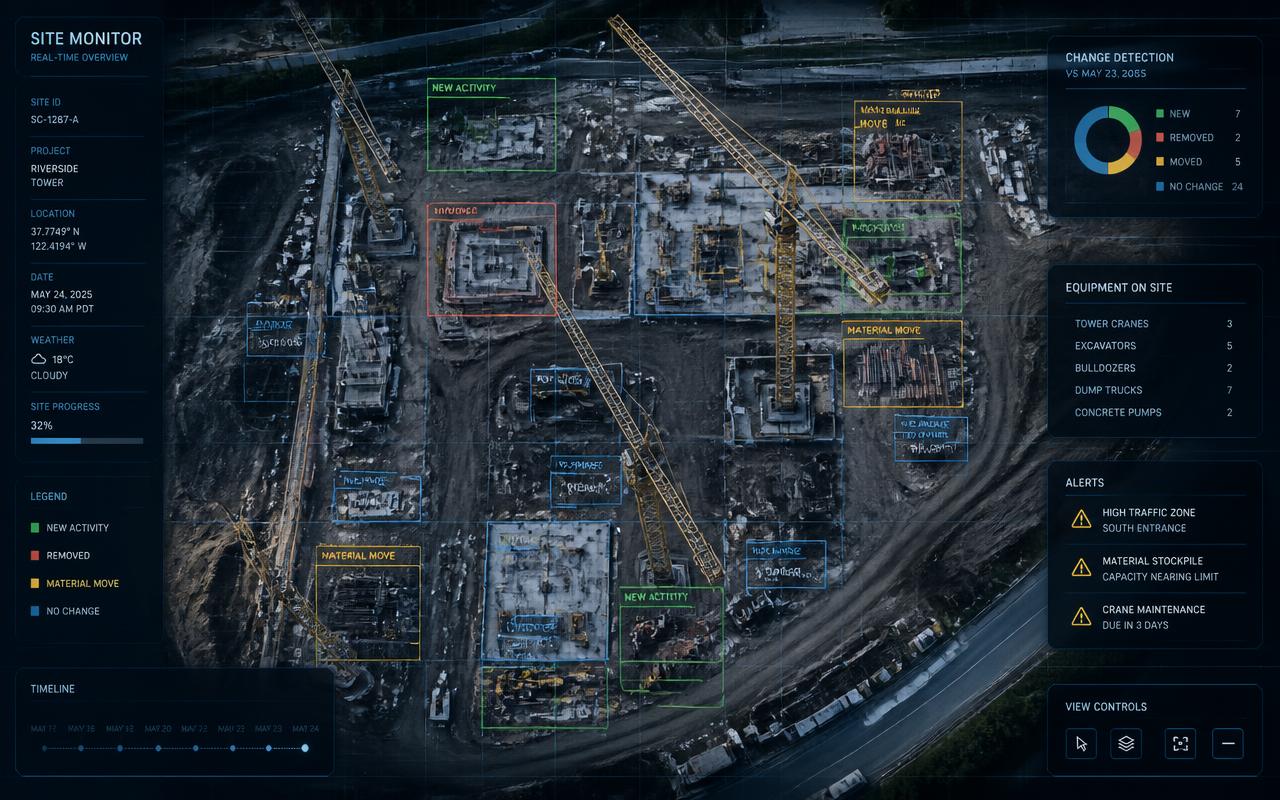
Every milestone on a draw schedule has a visible signature from orbit — cleared earthwork, poured slabs, structural framing, a closed building envelope, new paving. Modern satellite platforms capture the site every 3–5 days, run computer-vision change detection against the prior baseline, and quantify what changed as a percentage. When a borrower submits a draw request, the lender matches it to the most recent satellite capture and confirms the claimed work actually exists — without dispatching a human. The imagery is independently time-stamped by the satellite operator, impossible to backdate, and delivered as a PDF report that drops directly into the loan file. Most 2026 lenders keep in-person inspections for kickoff, major milestones, and final CofO, and use satellite verification for every draw in between. Typical results: 60–80% fewer inspector visits, direct-cost savings around $10,000–$18,000 per loan, and stall detection an average of four weeks earlier than an inspector-only workflow.
Comparing draw verification options in 2026
Third-party inspector — $175–$3,500 per visit, gold-standard for physical walk-through, slow to schedule in remote areas. Fixed jobsite camera — $200–$500/month per camera plus install, great for security and time-lapse, single-angle only. Drone flight — $400–$1,200 per flight, beautiful survey-grade output, needs a certified pilot and weather window. Satellite monitoring — $149–$249/site/month, worldwide coverage, 3–5 day revisit, no on-site hardware, best fit for verifying visible exterior progress on every draw. The right answer for most lenders is a hybrid: satellite for continuous progress verification plus a physical inspector at major milestones.
How to run a draw process that holds up
(1) Lock the draw schedule and milestone definitions in the loan agreement, with explicit physical-condition language for every draw. (2) Enable continuous satellite monitoring at loan close so the baseline capture predates any work. (3) When a draw request arrives, match it to the latest satellite capture, run a side-by-side against the prior milestone, and verify the percent-change supports the request. (4) Send the physical inspector only for major structural milestones and final CofO. (5) Release funds within 5–10 business days, apply retention, and archive all imagery and reports as audit evidence in the loan file. The result: faster draws on healthy projects, earlier intervention on troubled ones, and a paper trail that holds up if the loan ever has to be enforced.
The bottom line on construction draws in 2026
A construction draw is no longer just a paperwork event — it's an evidence event. The lenders who win the next cycle are the ones who treat every draw as a checkpoint backed by objective, independently captured data. Satellite monitoring doesn't replace the discipline of a well-written draw schedule or a skilled construction loan administrator; it upgrades the verification layer so the discipline actually holds. Combine a tight schedule, clear milestone language, retention, and continuous satellite verification, and the construction draw stops being the riskiest step in the loan and starts being the strongest.
FAQ
Frequently asked questions
What is a construction draw?
A construction draw is a scheduled partial disbursement of a construction loan, released as physical work is completed and verified. Instead of a lump-sum payout at closing, the loan is drawn down in 5–10 milestone-based installments over the life of the project.
How does the construction draw process work?
The borrower submits a draw request (usually monthly) with supporting documentation, a third-party or satellite draw inspection verifies the claimed work physically exists, the lender reviews and applies retention (typically 5–10%), and approved funds are wired from escrow — usually within 5–10 business days.
What is a draw inspection?
A draw inspection is a third-party verification that the work claimed on a draw request actually exists on the site. The inspector walks the property, estimates percent-complete on each budget line item, photographs conditions, and issues a report the lender uses to approve or reduce the requested draw.
How much does a construction draw inspection cost?
In 2026, residential draw inspections run $175–$450, mid-size commercial $500–$1,500, and large or remote projects $1,200–$3,500. Total per-loan inspection spend on a 24-month vertical build typically lands between $6,000 and $24,000.
How many draws are in a typical construction loan?
Most vertical construction loans use 5–10 draws tied to milestones: site prep, foundation, framing, dry-in, rough MEP, drywall, finishes, punch list, and final retention release after certificate of occupancy.
Can satellite imagery replace a draw inspector?
For visible exterior progress, yes — satellite platforms like Terra Trace IQ verify each milestone with independently time-stamped imagery on a 3–5 day revisit, cutting 60–80% of inspector visits. Most lenders keep in-person visits for kickoff, major structural milestones, and final CofO, and use satellite for every draw in between.
Pricing
Start monitoring your sites this week
Month-to-month plans, cancel anytime. Every plan includes weekly satellite captures, AI change detection, and automated PDF reports.
Starter
For lenders and developers monitoring a single active project.
- 1 active site
- Weekly satellite captures
- Automated PDF reports
- Email support
Growth
For portfolios of 2–25 active loans or projects.
- Up to 25 sites
- Daily captures + alerts
- Branded reports + API
- Portfolio dashboard
Enterprise
For institutional lenders, funds, and insurers at scale.
- Unlimited sites
- SSO / SAML
- Dedicated CSM
- Custom SLAs
A traditional in-person draw inspection costs $1,200–$3,500. Satellite monitoring delivers weekly verification for a fraction of that — see the full pricing page for volume discounts.