Construction Loan Draw Schedule: The Lender's 2026 Guide & Template
A practical guide to building a construction loan draw schedule — milestone percentages, sample template, common pitfalls, and how satellite monitoring objectively verifies each milestone before funds are released.
A construction loan draw schedule is the milestone-by-milestone funding plan that governs when a lender releases capital to a borrower during construction. Done well, it protects the lender from over-funding, gives the borrower predictable cash flow, and creates a clear record of progress. Done poorly, it becomes the single biggest source of disputes, delays, and losses on a construction loan.
This guide walks through what a draw schedule actually contains, a reusable template you can adapt for vertical construction, the five mistakes that cause most draw disputes, and how satellite monitoring verifies each milestone objectively before funds leave escrow.
What is a construction loan draw schedule?
It's a contractual schedule — usually attached as an exhibit to the loan agreement — that splits total loan proceeds into a sequence of draws tied to defined construction milestones. Each draw releases a fixed dollar amount (or a percentage of total budget) once the corresponding milestone is verified as complete. The schedule typically lists the milestone name, the budget line items it covers, the dollar amount, the percentage of total loan proceeds, and the documentation required to release funds.
A typical vertical-construction draw schedule template — adjust percentages to match your project
Draw 1 — Site prep, demolition, grading and excavation: 5–10% of loan. Draw 2 — Foundation and underground utilities: 10–15%. Draw 3 — Structural framing and roof deck: 15–20%. Draw 4 — Dry-in: roofing, exterior sheathing, windows, doors: 10–15%. Draw 5 — Rough mechanical, electrical, plumbing (MEP): 10–15%. Draw 6 — Insulation, drywall, interior framing: 5–10%. Draw 7 — Finishes: flooring, paint, cabinetry, fixtures: 10–15%. Draw 8 — Final MEP trim, appliances, punch list: 5–10%. Draw 9 — Certificate of occupancy and final retention release: 5–10%. Most lenders also hold a 5–10% retention on each draw, released only at substantial completion.
Required documentation for each draw
Standard packages include: signed draw request form (AIA G702/G703 or lender's template), updated sworn construction statement, lien waivers from the GC and major subs, current building permit and inspection sign-offs, recent dated progress photos, an inspector's report verifying milestone completion, and updated insurance certificates. Many lenders now accept satellite-verified progress reports in place of (or alongside) the third-party inspector report — the imagery is independently time-stamped and impossible to backdate.
Five mistakes that cause most draw disputes
(1) Front-loading the schedule: borrowers push for outsized early draws to cover acquisition or soft costs, leaving the lender over-funded if the project stalls. Cap early draws at the percentage of physical work actually complete. (2) Vague milestone definitions: 'framing complete' means different things to different inspectors. Specify the physical condition required — e.g., 'all structural framing in place, roof sheathing installed, building dried-in.' (3) No retention: skipping the 5–10% retention removes the borrower's incentive to finish punch list items. (4) Inspector schedule mismatch: scheduling inspections days after the draw request creates pressure to approve incomplete work. Pre-schedule inspections to coincide with claimed completion. (5) No independent verification: relying solely on the borrower's photos and the GC's pay app invites fraud — the three most common schemes (phantom progress, recycled photos, equipment theater) all collapse under continuous satellite verification.
How satellite monitoring verifies the draw schedule
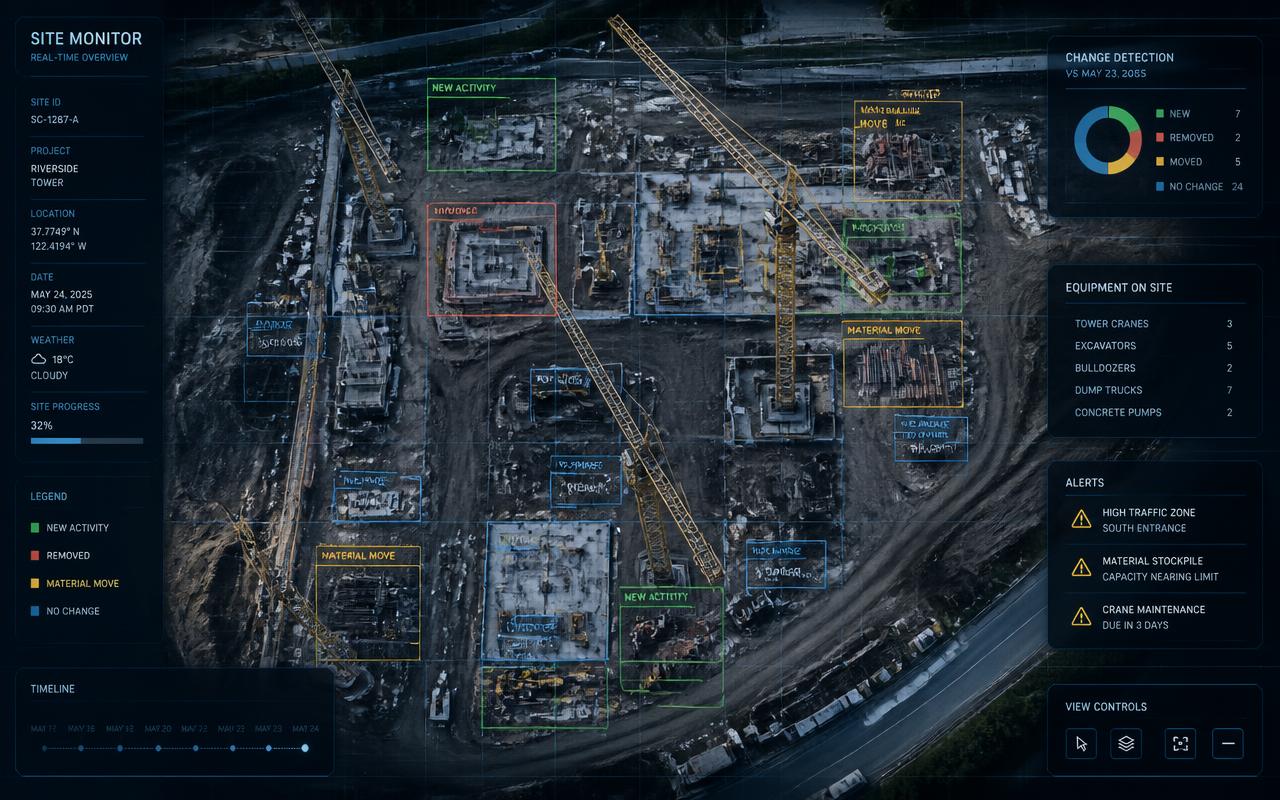
Each milestone on a draw schedule has a visible physical signature — earthwork shows up as cleared and graded ground, foundations as concrete slabs, framing as structural steel or wood members, dry-in as a closed building envelope, paving as new asphalt. Terra Trace IQ captures the site on a 3–5 day revisit cadence, runs computer-vision change detection against the prior baseline, and quantifies what changed. When a borrower submits a draw request for, say, 'Draw 3 — structural framing complete,' the lender can match the request to the latest satellite capture and confirm the building envelope actually exists before approving the funds.
Pricing the verification step
A traditional third-party inspector charges $1,200–$3,500 per draw inspection. On a 24-month loan with eight draws plus quarterly progress visits, that's $16,000–$24,000 per project. Satellite monitoring at $149–$199/site/month delivers weekly verification for $3,576 over the same term — roughly 78% lower direct cost, with every milestone backed by independently captured imagery rather than a single point-in-time photo.
Putting it together — a draw process that holds up
(1) Lock the draw schedule and milestone definitions in the loan agreement, with explicit physical-condition language. (2) Enable continuous satellite monitoring on the site at loan close. (3) When a draw request arrives, match it to the latest capture and run a side-by-side against the previous milestone capture. (4) Release funds only when the satellite-verified percent-change supports the claimed milestone. (5) Keep all imagery and reports in the loan file as audit evidence. The result is faster draws on healthy projects, earlier intervention on troubled ones, and a draw process that holds up to scrutiny if the loan ever has to be defended.
Pricing
Start monitoring your sites this week
Month-to-month plans, cancel anytime. Every plan includes weekly satellite captures, AI change detection, and automated PDF reports.
Starter
For lenders and developers monitoring a single active project.
- 1 active site
- Weekly satellite captures
- Automated PDF reports
- Email support
Growth
For portfolios of 2–25 active loans or projects.
- Up to 25 sites
- Daily captures + alerts
- Branded reports + API
- Portfolio dashboard
Enterprise
For institutional lenders, funds, and insurers at scale.
- Unlimited sites
- SSO / SAML
- Dedicated CSM
- Custom SLAs
A traditional in-person draw inspection costs $1,200–$3,500. Satellite monitoring delivers weekly verification for a fraction of that — see the full pricing page for volume discounts.